When developing a cleaning product, brands often try to improve several properties at the same time: absorbency, softness, cleaning power, durability, and overall feel.
The problem is that these properties do not always move in the same direction.
A more aggressive surface may clean better but feel less comfortable. A very soft fabric may provide a premium touch but lack the texture needed for heavier cleaning. Increasing thickness may make a product feel more substantial, but it can also increase weight and cost.
This is one reason double-layer textile construction is attracting attention in product development.Instead of asking one fabric to do everything, brands can combine two complementary layers and design each one around a specific requirement.
For microfiber and cleaning products, this can create new possibilities—not only for performance, but also for product feel, appearance, functionality, and perceived quality.
Why Can't One Fabric Do Everything?
Single-layer fabrics remain the simplest and most economical option for many applications. When the required performance is straightforward, there may be no reason to add another layer.
The challenge appears when a product needs several characteristics that are difficult to optimize simultaneously.
For example, a cleaning cloth may need to be:
Absorbent enough to pick up liquids
Strong enough for repeated use
Soft enough for delicate surfaces
Textured enough to remove dirt
Attractive enough for a premium retail product
Trying to achieve all of these properties through one fabric can involve compromises.
This is where double-layer design becomes interesting.
Rather than continuously modifying one material, manufacturers can introduce a second surface with a different structure or material.
The goal is not simply to make the fabric thicker.
The goal is to give the product more design possibilities.
What Changes When You Add a Second Layer?
A double-layer product combines two textile layers into one finished construction.
The layers can be made from the same material with different structures, or from different materials designed to complement each other.
For example:
Cleaning surface + polishing surface
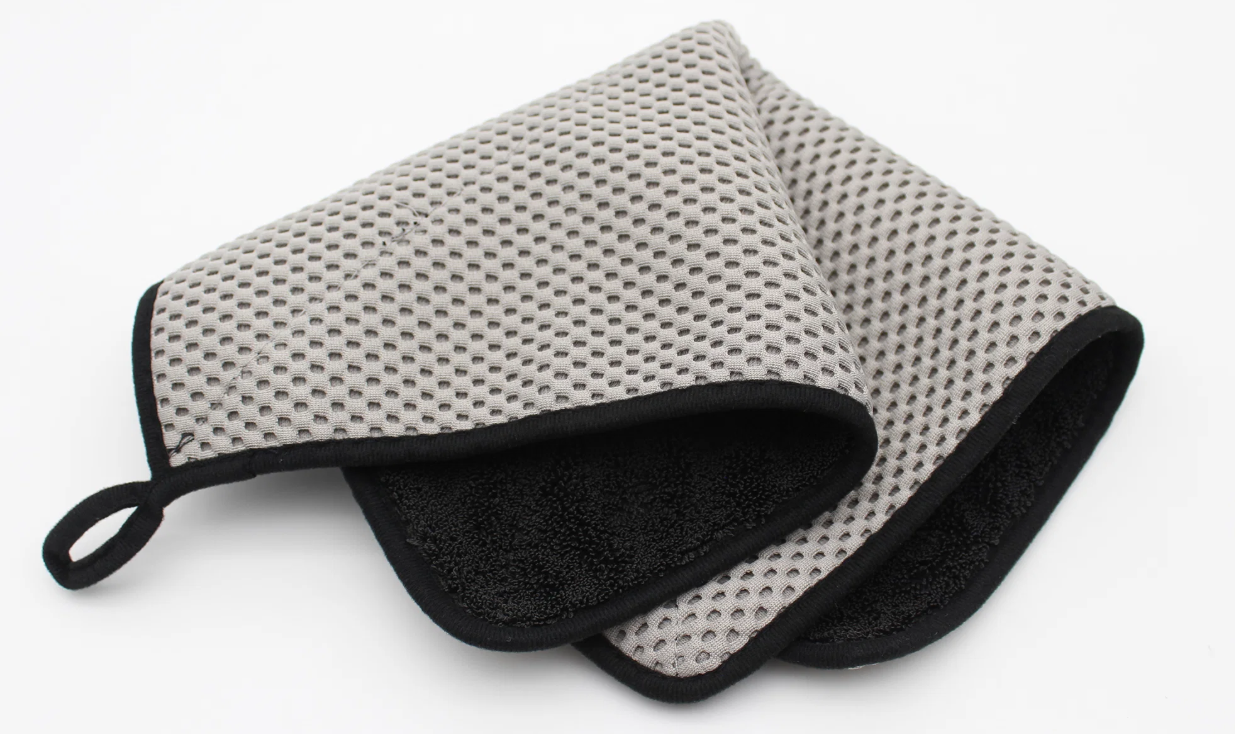
Absorbent surface + scrubbing surface
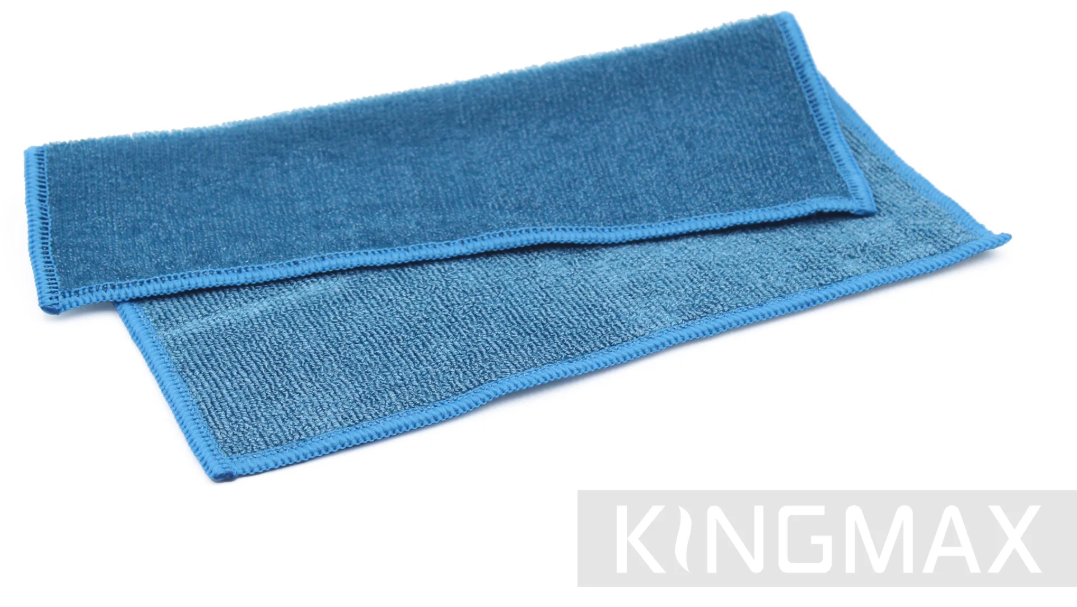
Durable surface + soft-touch surface
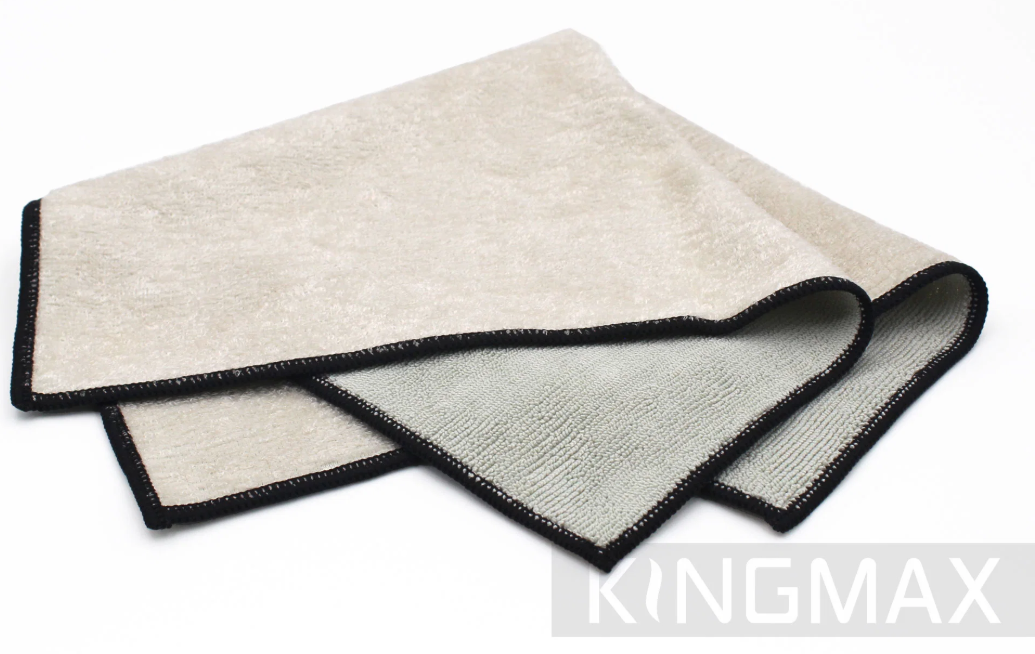
This approach allows the product to perform different tasks without requiring every property to come from a single layer.
For a consumer, the result may be as simple as turning the cloth over.
For a product developer, however, it opens up a much larger design space.
From Traditional Double Cloth to Modern Composite Textiles
The idea of combining two textile layers is not new.
Traditional double cloth and double-weave fabrics have existed for centuries, with two textile layers formed and connected during the weaving process.
Modern composite textile production developed in a different direction. With the development of synthetic fibers, polymer materials, and industrial adhesives during the 20th century, manufacturers gained the ability to combine separately produced textile materials through lamination and bonding.
This made it possible to combine materials that could not easily be produced as a single woven or knitted structure.
Today, double-layer and laminated textiles are used in areas ranging from apparel and outdoor products to automotive interiors, home textiles, medical products, and technical textiles.
The important development is therefore not simply the existence of two layers.
It is the ability to select and engineer each layer according to the final product requirement.
What Can the Two Layers Be?
There is no universal combination that works for every product.The best approach is to start with the function and then select materials accordingly.
For cleaning and microfiber products, several combinations can be particularly useful.
| Layer A | Layer B | Potential Product Concept |
| Cleaning microfiber | Soft polishing surface | Cleaning + finishing |
| Absorbent microfiber | Textured surface | Absorbing + scrubbing |
| Polyester-rich microfiber | Polyamide-rich microfiber | Durability + softness |
| Microfiber | Bamboo-based textile | Performance + natural feel |
The important principle is complementarity.
Combining two layers with almost identical characteristics may add cost without creating meaningful value. Combining two surfaces with different but complementary properties can create a much stronger product concept.
How Are Two Fabric Layers Combined?
Once the desired structure has been defined, the next question is how the layers should be joined.Different manufacturing methods create different results.
Adhesive Lamination
In adhesive lamination, two textile layers are joined using an adhesive.
Depending on the application, the adhesive may be applied as a liquid coating, film, web, powder, or other form.
The adhesive itself matters. It can influence flexibility, hand feel, peel strength, washing resistance, and durability.
For a cleaning product that needs to remain soft and flexible, for example, simply achieving a strong bond is not enough. The bonding system must also maintain the desired user experience.
Hot-Melt Bonding
Hot-melt lamination uses a thermoplastic adhesive that softens when heated and forms a bond as the materials are pressed together and cooled.
It can support continuous production and is widely used in modern textile bonding applications.
However, temperature and pressure need to be controlled carefully, particularly when working with materials that may be sensitive to heat.
Quilting and Stitching
Not every double-layer product needs adhesive.
Two or more layers can also be mechanically connected through stitching or quilting.
This approach is particularly useful when the product requires additional thickness, cushioning, structure, or a more pronounced tactile effect.
What Does Double-Layer Construction Actually Improve?
The value of a second layer should be evaluated in several dimensions.
1. Functional Performance
Different surfaces can be optimized for different tasks.
A textured surface can provide stronger cleaning action, while another surface can be designed for softer finishing. An absorbent layer can handle liquid, while another surface provides durability or scrubbing.
This is particularly useful for products designed around multiple cleaning steps.
2. Tactile Quality and Premium Feel
This is an often-overlooked advantage.A product's perceived quality is influenced not only by its specifications, but also by how it looks and feels in the hand.
Combining different materials, textures, or structures can create a fuller, more substantial, and more sophisticated tactile experience.
For premium cleaning and household brands, this can be valuable because the product itself—not just the packaging—can communicate quality.
A standard microfiber cloth may feel like a commodity product.
A carefully designed dual-surface product can feel more intentional and purpose-built.
3. Visual Differentiation
Different colors, textures, and surfaces can create greater visual depth.
Instead of selling another single-color cloth with customized packaging, a brand can use the fabric structure itself as part of its product identity.
4. Product Functionality
Two complementary surfaces can also create a clear 2-in-1 product concept.
For example:
Side A: Clean
Side B: Finish
This is easy for consumers to understand and can make a product more distinctive at retail.
Is Double-Layer Always Better Than Single-Layer?
No.
This is an important part of the product-development decision.
A double-layer construction usually requires more material and additional manufacturing processes. This can increase cost, weight, thickness, and production complexity.
The bonding method may also affect flexibility and hand feel. If the materials or adhesive are poorly matched, the finished product may become too stiff or experience bonding problems over time.There can also be sustainability considerations. A product made from several different materials permanently bonded together may be more difficult to separate or recycle at the end of its useful life.
So the right question is not:
“Can we make this product double-layer?”
It is:
“Does the second layer solve a problem that is important enough to justify the additional complexity?”
When Should a Brand Consider Double-Layer Design?
Double-layer construction can be particularly interesting when a brand wants to achieve one or more of the following:
A product with two distinct functions
For example, cleaning on one side and polishing on the other.
A more premium tactile experience
Different materials or textures can make the product feel more substantial and refined.
A stronger point of differentiation
A customized structure can be more distinctive than simply changing color, size, or packaging.
A new product concept
A reversible or dual-surface product can create a new SKU rather than another variation of an existing cloth.
Better alignment between material and application
Instead of selecting one material that compromises between several requirements, each layer can be designed around a more specific task.
From Fabric Design to Product Design
This is where double-layer development becomes more than a textile decision.A common mistake is to start with:“Which two fabrics should we combine?”A better development process starts with:
“What does the product need to do?”
The development logic can then follow:
Application
↓
Required functions
↓
Surface A
↓
Surface B
↓
Material and structure
↓
GSM and dimensions
↓
Bonding or stitching method
↓
Finishing and edge construction
↓
Packaging and final product
For example, a premium car-care brand may prioritize a soft finishing surface and controlled cleaning performance.
A household cleaning brand may instead prioritize absorbency and scrubbing.
The double-layer structure should therefore be developed around the application, target customer, and desired product positioning.
How Kingmax Approaches Double-Layer Microfiber Development
At Kingmax, we believe double-layer product development should start with the customer's application, rather than with a fixed material combination.
Our role is not simply to combine two fabrics.We can work with brands to evaluate the relationship between:
Material composition → Fabric structure → GSM → Texture → Absorbency → Cleaning performance → Hand feel → Bonding method → Edge construction → Packaging
This is particularly important for OEM and ODM projects, where the objective is not to reproduce a generic double-layer cloth, but to develop a product that fits a specific market and brand.
For example, if the goal is a premium automotive detailing product, we may focus more heavily on softness, finishing performance, tactile quality, and surface safety.
If the product is designed for household cleaning, absorbency, cleaning efficiency, durability, and cost may take priority.
The right double-layer product is not the one with the most complicated construction. It is the one where every layer has a clear purpose.
Where Is Double-Layer Textile Design Heading?
As cleaning and household categories become more competitive, brands need more than another standard microfiber cloth.
This is likely to drive further development toward application-specific and multifunctional textile structures.
For cleaning products, we expect continued interest in dual-purpose surfaces, reversible products, different textures, premium tactile experiences, and more carefully selected material combinations.
Sustainability will also become increasingly important. Future composite products will need to consider material compatibility, adhesive selection, product lifespan, and end-of-life options alongside performance.
The direction is therefore not simply toward more layers.It is toward better-designed layers.
Conclusion: The Second Layer Should Have a Purpose
Double-layer textile construction is not a replacement for single-layer fabric.
For many applications, a well-designed single-layer material remains the most practical solution.
But when a product needs to combine different functions, improve tactile quality, create a more premium feel, or stand out from conventional products, a second layer can provide valuable new possibilities.
The key is to start with the problem—not the fabric.
What does the product need to do? What should the customer feel? And what can each surface contribute?
Once those questions are clear, material selection, structure, bonding method, and finishing can be developed around them.
For brands looking to develop a differentiated microfiber or cleaning product, this is where a manufacturing partner can add value—not simply by producing the fabric, but by helping turn a product idea into a workable specification.
Have a double-layer product idea in mind? Talk to Kingmax about the materials, structure, and manufacturing approach that could bring it to life.
FAQ
What is a double-layer composite fabric?
It is a textile product made by combining two fabric layers into one construction. The layers may use different materials, structures, or surface textures depending on the intended application.
Is double-layer fabric the same as laminated fabric?
Not necessarily. Lamination is one method of creating a double-layer structure. Other methods include stitching, quilting, double weaving, and double knitting.
Does double-layer fabric always require adhesive?
No. Adhesive and hot-melt bonding are common methods, but some double-layer structures are created through stitching, weaving, or knitting.
Is double-layer fabric better than single-layer fabric?
Not automatically. It is most useful when the second layer provides a meaningful function or improves the product experience enough to justify the additional cost and complexity.
Can double-layer microfiber improve the feel of a product?
Yes. Different materials, textures, and structures can create a fuller, softer, or more sophisticated hand feel and contribute to a more premium perceived quality.
What are common double-layer microfiber combinations?
Depending on the application, combinations can include polyester and polyamide, microfiber and bamboo-based textiles, absorbent and textured surfaces, or cleaning and polishing surfaces.
Can Kingmax develop customized double-layer microfiber products?
Yes. Kingmax can work with brands on material composition, GSM, size, texture, structure, bonding or stitching methods, finishing, edge construction, and packaging for OEM/ODM development.
Is double-layer construction suitable for private-label cleaning products?
Yes. It can be particularly useful when a brand wants a more distinctive product concept, such as a dual-purpose, reversible, or premium cleaning cloth rather than a standard single-layer microfiber product.
Comments