Sustainable Packaging Is Moving Beyond Traditional Solutions
For many years, transparent plastic bags were the standard choice for packaging products across many industries. They were practical, affordable, and allowed customers to see the product before making a purchase. For manufacturers and brands, plastic packaging offered a simple balance between product protection, transportation efficiency, and cost control.
However, the role of packaging is changing.
Today, packaging is no longer viewed only as a protective layer around a product. For many brands, it has become part of the product experience and an important way to communicate brand values.
This change is particularly visible in industries where product quality, craftsmanship, and sustainability are becoming increasingly important.
At Kingmax, as a microfiber manufacturer working with international brands, we have noticed that customers are paying more attention not only to the performance of microfiber products but also to how those products are presented.
A premium microfiber towel represents quality, attention to detail, and professional standards. When such a product is placed inside traditional plastic packaging, the packaging may not fully support the message that the product itself is trying to communicate.
This has led many brands to reconsider an important question:
Does sustainable packaging always mean replacing transparent packaging with paper boxes?
The answer is no.
The development of new materials has created more possibilities. Transparent packaging is no longer limited to conventional plastic. Cellulose-based solutions, including Glassine bags, are becoming an interesting option for brands that want product visibility while moving toward more responsible packaging choices.
The Changing Perception of Transparent Packaging
The popularity of plastic packaging was built on practicality.Plastic bags are lightweight, flexible, durable, and easy to manufacture at scale. These advantages made them widely used in industries ranging from textiles and household products to cleaning supplies and automotive accessories.
For many years, the main consideration was efficiency. A package needed to protect the product, reduce damage during transportation, and keep the overall cost competitive.
As sustainability became a stronger consideration, brands began looking beyond traditional plastic solutions.
The challenge was not simply removing plastic. The real challenge was finding packaging that could still meet commercial requirements while aligning with changing consumer expectations.
Some brands explored recycled plastic packaging as a way to reduce the use of virgin materials. Others investigated bio-based materials such as PLA, which uses renewable resources as a starting point.
These developments expanded the range of sustainable packaging options. However, they also showed that there is no single solution suitable for every product category.
Different materials have different strengths. Some provide stronger moisture protection. Some offer better transparency. Some create a more natural customer experience.
This is why cellulose-based packaging has attracted increasing attention.
Rather than trying to make another type of plastic, cellulose packaging takes a different approach by returning to plant-based fiber materials.Glassine bags are one example of this movement.
What Is a Glassine Bag?
A Glassine bag is a translucent paper-based packaging solution made from highly refined cellulose fibers.
The main raw material is cellulose, which is commonly obtained from wood pulp or other plant-based sources.
Unlike traditional plastic bags, the transparency of Glassine does not come from a plastic film layer. Instead, it is created through the way cellulose fibers are processed and compressed during manufacturing.
This gives Glassine its distinctive characteristics. The material has a smooth surface, a soft paper-like feel, and a semi-transparent appearance that allows customers to see the product inside.
This balance between natural appearance and product visibility is one of the reasons why Glassine has become increasingly interesting for premium brands.
Historically, Glassine has been used in applications such as food packaging, envelopes, stationery, and specialty product protection. Today, with growing interest in plastic-free packaging, brands across different industries are exploring its potential for retail packaging.
For products such as microfiber towels, where texture, color, and quality are important parts of the buying experience, Glassine provides an alternative way to present the product without relying on conventional plastic packaging.
How Glassine Bags Are Manufactured
Understanding the production process helps explain why Glassine is different from ordinary paper packaging.
The process begins with cellulose fiber preparation. Plant-based materials are processed to separate cellulose fibers, which are then refined and prepared for paper production.
After the paper sheet is formed and dried, Glassine undergoes an additional process known as supercalendering.
This process uses high-pressure rollers to compress and smooth the paper structure. The fibers become more tightly arranged, reducing internal gaps and changing how light passes through the material.
The result is the characteristic translucent appearance of Glassine.
After production, Glassine paper can be converted into different packaging formats depending on product requirements. Brands can customize bag sizes, printing designs, and packaging structures to match their product positioning.
Why Brands Are Exploring Cellulose-Based Packaging
The growing interest in Glassine bags is part of a wider shift toward cellulose-based packaging.Cellulose is one of the most abundant natural materials on earth. It forms the structure of plants and can be sourced from renewable resources. For brands looking to reduce dependence on traditional plastic packaging, cellulose provides another direction worth considering.
However, the value of cellulose packaging is not only about the material itself.Packaging also communicates something about a brand.
When customers receive a product, the packaging becomes the first physical interaction they have with the brand. A package made from natural fiber materials creates a different impression compared with conventional plastic. It feels more connected to concepts such as craftsmanship, responsibility, and thoughtful product development.This is especially relevant for premium microfiber products.
Many microfiber brands today are no longer competing only on basic functions such as absorption or cleaning performance. They are building complete product experiences around quality, professional use, and sustainability.
In this context, packaging becomes part of the overall product story.
A well-designed sustainable package can help reinforce the message that a brand pays attention to every detail, from the material inside the package to the package itself.
At the same time, sustainability claims need to be communicated carefully.
No packaging material has zero environmental impact. Every material involves decisions related to sourcing, manufacturing, transportation, and end-of-life management.
A responsible approach is not to claim that one material solves every environmental challenge, but to evaluate whether a packaging solution creates a better balance between functionality and environmental considerations.
Glassine Bags, PLA Packaging, or Traditional Plastic: Choosing the Right Solution
The discussion around sustainable packaging is sometimes simplified into choosing the “most environmentally friendly” material.
In reality, packaging decisions are more complicated.
Every material has advantages and limitations.
Traditional plastic packaging remains widely used because it offers excellent durability, moisture resistance, and cost efficiency. For certain products and applications, these characteristics remain valuable.
PLA packaging provides another option. As a bio-based polymer, PLA can reduce dependence on conventional petroleum-based plastics and offers a similar appearance to traditional plastic packaging. However, its end-of-life performance depends on specific processing conditions and infrastructure.
Glassine represents a different category of packaging material. Made from highly refined cellulose fibers and processed through supercalendering, it has a smooth surface, high density, and a distinctive translucent appearance. Compared with ordinary paper packaging, Glassine offers better grease resistance and a more refined texture, making it suitable for products where both material presentation and product visibility are important.
While it does not provide the same moisture barrier and durability as plastic films, its natural fiber composition and unique appearance make it an attractive option for brands looking to develop more responsible packaging solutions.
The right choice depends on the product.For a product that requires strong moisture barriers and maximum durability, one material may be more suitable.
For a premium microfiber towel where brand image, product visibility, and sustainability communication are important, Glassine may offer a valuable alternative.
The goal is not replacing one material with another in every situation. The goal is selecting packaging that matches the product and the brand.
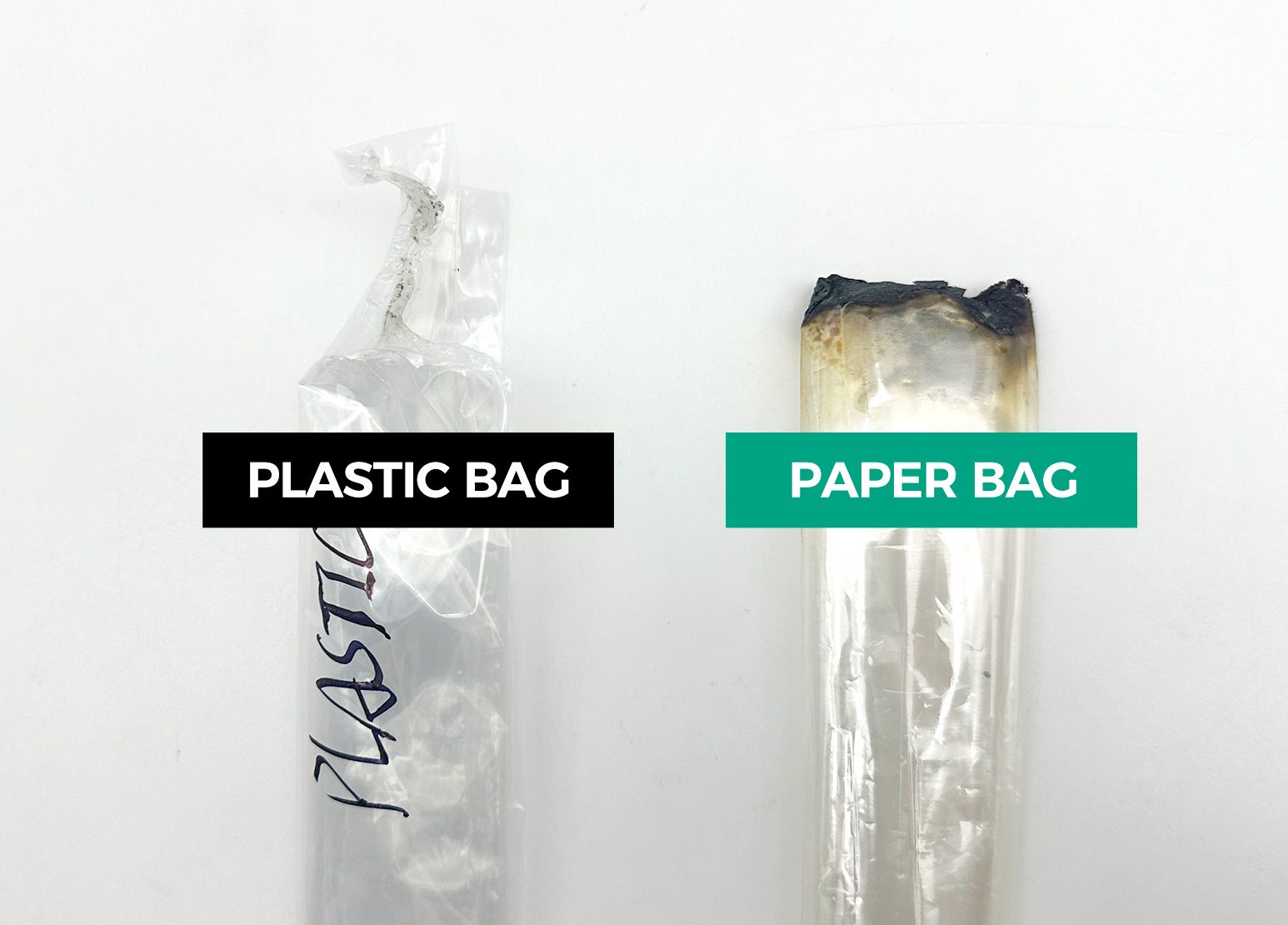 How Can Consumers Distinguish Fiber-Based Packaging From Plastic?
IGNITING.
As sustainable packaging becomes more common, consumers are naturally becoming more interested in understanding material differences.
One simple way to observe the difference between fiber-based materials and plastic is to see how they react to heat.
Paper-based materials such as Glassine generally behave similarly to natural paper when exposed to flame. They burn and leave behind ash rather than forming a melted plastic-like residue.
Traditional plastic materials usually respond differently. They tend to shrink, soften, and melt when heated.This type of observation can help consumers develop a basic understanding of different material categories.
However, it is important to understand that this is only an informal observation method.
A burning test cannot determine the complete composition of packaging materials, and it cannot replace professional verification.
For brands making sustainability claims, reliable evidence should come from:
Material specifications
Supplier documentation
Certification systems
Professional testing when required
Transparency is the foundation of credible sustainability communication.

Why Sustainable Packaging Matters for Microfiber Brands
For many years, microfiber products were mainly judged by their functional performance.
Customers looked at factors such as softness, absorption, durability, cleaning ability, and surface safety.
These factors remain important.However, the market is evolving.
Many microfiber products today are positioned as premium solutions rather than simple cleaning accessories. This is especially true in automotive detailing, professional cleaning, and high-end household markets.
As product positioning becomes more sophisticated, every part of the customer experience becomes important.
The fabric quality matters.
The product design matters.
The packaging matters.
At Kingmax, we have seen this shift through our cooperation with international customers. Brands are increasingly looking for solutions that allow their products to communicate quality before the customer even uses them.
This is why packaging development has become a natural extension of product development.
A microfiber product with carefully selected materials and thoughtful packaging creates a more consistent brand experience.
Developing a More Complete Sustainable Microfiber Solution
Sustainability in microfiber products is not limited to one decision.
It is a combination of material selection, manufacturing processes, packaging choices, and responsible communication.
Depending on market positioning and product requirements, brands may explore different approaches.
Some products may benefit from cellulose-based packaging such as Glassine bags, especially when the goal is creating a premium, natural, and plastic-free presentation.
Other products may require transparent compostable packaging solutions where visibility and protection are higher priorities.
Printing choices can also influence the overall packaging concept. Using more responsible printing methods and avoiding unnecessary material combinations can help create a packaging solution that better matches sustainability goals.
At Kingmax, our focus has always been helping brands develop microfiber products that balance performance, customization, and market expectations.
As sustainability becomes an increasingly important factor in purchasing decisions, we believe packaging should be considered together with the product itself.
A successful product solution is not only about what customers receive.It is also about the story that the product communicates.
The Future of Packaging Goes Beyond Plastic Replacement
For many years, transparent packaging was almost automatically associated with plastic.Today, this assumption is changing.
The development of cellulose-based materials has created new opportunities where product visibility, functionality, and sustainability can exist together.
Glassine bags represent one example of how packaging is evolving.For microfiber brands, sustainable packaging is becoming more than a packaging choice. It is becoming part of the overall brand experience.
At Kingmax, we believe the future of sustainable products will not only depend on better materials inside the package, but also on better decisions around every stage of the product journey.
From microfiber development to packaging solutions, every detail contributes to how customers understand and experience a brand.
About Kingmax
Kingmax specializes in microfiber product development and manufacturing, providing customized solutions for automotive detailing, household cleaning, and professional cleaning applications.
With experience in material innovation, product customization, and sustainable packaging exploration, Kingmax works with brands to develop microfiber solutions that meet evolving market expectations.
By combining product performance with thoughtful packaging choices, Kingmax helps brands create products that are ready for the future of sustainable consumption.
Comments